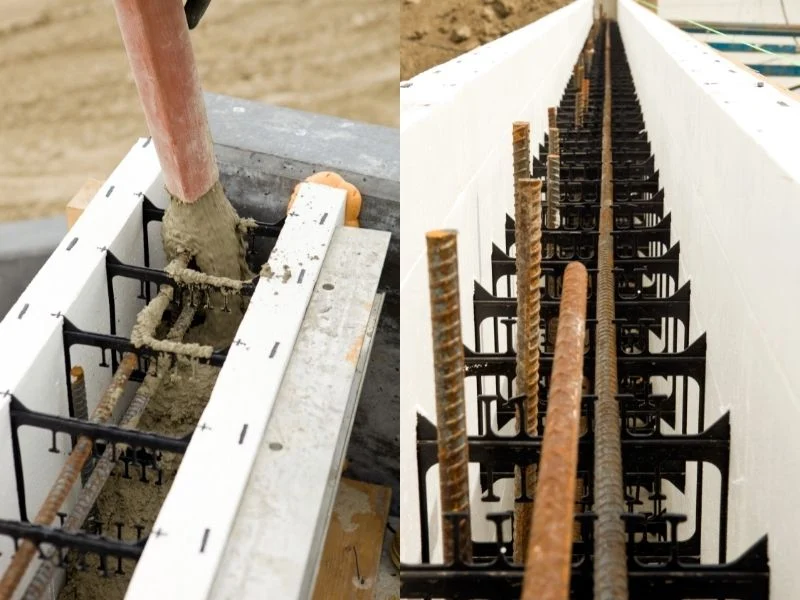

Homeowners and builders alike are increasingly interested in energy-efficient construction, not just for cost savings, but for comfort, sustainability, and long-term performance. Insulated Concrete Form (ICF) walls have emerged as one of the most scientifically advanced solutions for controlling indoor temperature. Unlike traditional wood-frame walls, which rely solely on insulation between studs, ICF walls integrate reinforced concrete with continuous insulation to create a wall system that excels in regulating heat flow. Understanding the physics behind how ICF walls manage temperature—through conduction, convection, and radiation—reveals why this building method consistently outperforms conventional construction in energy efficiency.
The Science of Heat Transfer: Conduction, Convection, and Radiation
Heat moves in three fundamental ways: conduction, convection, and radiation. Conduction is the process by which heat transfers directly through materials. In a standard wood-frame wall, heat moves quickly through wooden studs because wood is more conductive than the insulation placed between them. This creates thermal bridges, which allow energy to escape or enter the home, reducing efficiency and comfort. ICF walls, by contrast, sandwich a dense concrete core between continuous layers of foam insulation. The foam acts as a low-conductivity barrier, dramatically slowing heat transfer through conduction and minimizing thermal bridging.
Convection is the movement of heat through fluids, which includes air. In a poorly sealed wall system, air can move through gaps, cracks, and cavities, carrying heat with it. This is a common issue in traditional construction, where even well-installed insulation cannot completely stop air infiltration. ICF walls create a nearly airtight envelope, reducing the opportunity for convective heat loss. By limiting air movement through the wall, ICF construction maintains a stable indoor temperature, even when outdoor conditions fluctuate dramatically.
Radiation is heat transfer through electromagnetic waves, typically from warmer surfaces to cooler ones. While radiation is often less significant in comparison to conduction and convection in wall systems, it still contributes to overall heat gain or loss. The foam insulation in ICF walls reflects and absorbs some radiative heat, further improving energy efficiency. When combined with the thermal mass of the concrete core, this radiative control helps moderate temperature swings inside the home, making interior spaces more comfortable year-round.
Thermal Mass and Its Role in Temperature Regulation
One of the most important scientific principles in ICF construction is the concept of thermal mass. Thermal mass refers to a material’s ability to absorb and store heat energy, then release it slowly over time. Concrete has a high thermal mass, which allows ICF walls to act as a buffer against outdoor temperature fluctuations. During hot weather, the concrete core absorbs excess heat, preventing it from immediately entering the home. Conversely, in cold weather, the core retains interior heat and gradually releases it, helping maintain consistent indoor temperatures. Traditional wood-frame walls lack significant thermal mass, relying almost entirely on insulation, which only slows heat transfer but cannot store and redistribute thermal energy effectively.
The combination of thermal mass and continuous insulation in ICF walls creates a synergistic effect. While the foam layers slow down heat transfer, the concrete core moderates temperature swings, resulting in a more stable and comfortable indoor environment. The science is straightforward: materials with high thermal mass store energy, while insulating layers control the rate at which that energy is exchanged with the environment. Together, these elements reduce the demand on heating and cooling systems, leading to lower energy consumption and greater efficiency.
Continuous Insulation and the Elimination of Thermal Bridging
A critical factor in ICF temperature regulation is the presence of continuous insulation. In wood-frame construction, insulation is placed in sections between studs, leaving gaps where heat can pass through unimpeded. These gaps, known as thermal bridges, compromise energy efficiency, allowing heat to escape in the winter and enter in the summer. Even a well-insulated home will struggle to maintain consistent indoor temperatures if thermal bridging is present.
ICF walls eliminate this problem entirely. The foam insulation is continuous across the entire wall surface, creating a uniform barrier to heat flow. By removing thermal bridges, ICF construction significantly reduces unwanted heat transfer, making the home more energy-efficient. Studies have shown that ICF walls can outperform wood-frame walls by as much as 50% in energy efficiency, largely due to the combination of continuous insulation and thermal mass. The scientific explanation is simple: heat always seeks the path of least resistance, and ICF walls remove that path, keeping conditioned air where it belongs.
Airtight Construction and the Control of Airflow
Another key aspect of ICF performance is airtightness. Air leakage is a major source of energy loss in traditional homes. Gaps around windows, doors, and wall cavities allow warm or cool air to escape, forcing HVAC systems to work harder. This not only increases energy costs but also creates uneven indoor temperatures and reduces overall comfort.
ICF walls naturally create a tight building envelope. The foam panels, combined with the solid concrete core, prevent uncontrolled airflow through the wall system. When properly sealed around openings, the home becomes substantially more airtight than conventional construction. The reduced convective heat transfer means that the home requires less energy to maintain a comfortable indoor environment. The science here is clear: by minimizing air movement through walls, ICF construction maintains a more consistent interior climate and improves overall efficiency.
The Combined Effect: Energy Efficiency and Comfort
When considering conduction, convection, radiation, thermal mass, continuous insulation, and airtightness together, the advantages of ICF walls become undeniable. Each scientific principle reinforces the others, creating a wall system that performs far beyond what traditional construction can achieve. The combination of reduced heat transfer, moderated temperature swings, and controlled airflow leads to homes that are not only more energy-efficient but also noticeably more comfortable. Occupants experience fewer drafts, more consistent temperatures, and a quieter living environment due to the mass and density of the walls.
Moreover, the energy savings associated with ICF construction are measurable. Homeowners report lower utility bills and reduced demand on heating and cooling systems, making ICF homes both cost-effective and environmentally responsible. The building science behind these walls demonstrates that energy efficiency is not just a marketing term—it is a measurable outcome of careful design and material selection.
ICF in Different Climates
ICF walls perform exceptionally well in a wide range of climates, from hot and humid regions to cold and snowy areas. In warmer climates, the thermal mass absorbs excess heat during the day and releases it slowly at night, reducing the need for air conditioning. In colder regions, the combination of insulation and thermal mass keeps heat inside the home, minimizing energy use for heating. The airtight nature of ICF walls also prevents moisture intrusion and maintains a controlled indoor environment, which is especially important in climates with high humidity or extreme temperature swings.
The science behind these benefits is universal: the physical properties of concrete and foam, combined with careful design, control heat transfer regardless of external conditions. This versatility makes ICF construction a practical choice for homeowners across diverse geographic locations.
Long-Term Benefits Beyond Energy Efficiency
The temperature-regulating properties of ICF walls are just one part of a broader package of long-term benefits. Homes built with ICF experience lower HVAC maintenance needs, increased comfort, improved indoor air quality, and enhanced durability. Over time, these factors contribute to reduced operational costs and greater overall satisfaction for homeowners. The scientific principles behind ICF walls—thermal mass, continuous insulation, airtight construction, and moisture control—work together to create a building system that is resilient, efficient, and sustainable.
Furthermore, as building codes evolve to emphasize energy efficiency and sustainability, ICF walls position homeowners and builders to meet or exceed these standards. The physics of heat transfer and material performance ensures that homes built with ICF are not only ahead of their time but also future-proofed against rising energy costs and environmental concerns.
Conclusion: The Science Makes the Difference
The physics behind ICF walls explains why this construction method outperforms traditional wood-frame homes in temperature regulation and energy efficiency. By controlling conduction, convection, and radiation, leveraging thermal mass, providing continuous insulation, and creating an airtight envelope, ICF walls offer measurable, science-backed advantages. Homeowners benefit from reduced energy consumption, greater comfort, and a more resilient, durable home. As more people seek efficient, sustainable, and comfortable living spaces, the scientific principles of ICF construction continue to demonstrate why this technology is setting a new standard in modern building practices.